

Business Operation · 2025
In this section22 topics
- Corporate Information4 items
- Dividend Policy2 items
- Major Shareholders2 items
- Business Strategies Overview7 items
- Material Changes & Developments1 item
- Use of Proceeds from Securities Offerings3 items
- Commitments Made in the Registration Statement1 item
- Group Operating-Structure Policy1 item
- Companies Where the Company Holds ≥10%1 item
- Shareholders with Potential Conflict of Interest1 item
- Relationships Among Major Shareholders2 items
- Shareholders' Agreement1 item
- Shareholding Diagram (Group Structure)2 items
- Income Structure3 items
- Product / Service Characteristics2 items
- Research & Development6 items
- Assets Used in the Business4 items
- Marketing Policy & Competition4 items
- Procurement of Products & Services7 items
- Projects Under Construction1 item
- Debentures & Bills of Exchange1 item
- Convertible Securities1 item
Corporate Information
Company Name
THAI UNION FEEDMILL PUBLIC COMPANY LIMITED
Telephone
0-3441-7222
Website
www.thaiunionfeedmill.com
contact.tfm@thaiunion.com
Dividend Policy
Dividend Policy
The Board of Directors may consider declaring annual dividends, subject to approval by the shareholders’ meeting. However, in the case of interim dividends, the Board of Directors is authorized to approve such dividend payments from time to time when it deems that the Company has sufficient profits to justify such payouts, and shall report such interim dividend payments to the shareholders at the next shareholders’ meeting. The Company has a dividend policy to distribute dividends to shareholders at least twice a year, in an aggregate amount of no less than 50.0% of net profit based on the consolidated financial statements, after deduction of all statutory and other reserves as required by the Company’s Articles of Association and applicable laws. The amount of dividends paid shall not exceed the retained earnings shown in the separate financial statements of the Company. In considering dividend payments, the Board of Directors shall take into account various factors primarily in shareholders’ interests, including but not limited to the prevailing economic conditions, the Company’s operating results and financial position, cash flow, annual investment plans, and the necessity to retain funds for future business expansion. The Board will also consider the need to reserve funds for debt repayment or working capital, conditions and restrictions stipulated in loan agreements, and whether the dividend payment would have any material adverse impact on the Company's normal business operations, as well as any other factors deemed appropriate by the Board of Directors.
Historical Dividend Payments
| This Year | Last Year | 2 Years Ago | 3 Years Ago | 4 Years Ago | Metric | Description |
|---|---|---|---|---|---|---|
| 0.73 | 1.07 | 0.17 | 0.22 | 0.42 | Net profit per share (Baht : Share) | Net profit per share (baht : share) |
| 0.6 | 1.07 | 0.13 | 0.13 | 0.15 | Dividend per share (Baht : Share) | Dividend per share (baht : share) |
| 0 | 0 | 0 | Dividend stock ratio (Number of original shares: dividend shares) | Ratio of stock dividend payment (existing share : stock dividend) | ||
| 0 | 0 | 0 | 0 | 0 | Dividend share value per share (Baht : Share) | Value of stock dividend per share (baht : share) |
| 0.6 | 1.07 | 0.13 | 0.13 | 0.15 | Total dividend payment value (Baht : Share) | Total dividend payment (baht : share) |
| 81.83 | 100 | 74.4 | 59.34 | 35.46 | Dividend payout ratio to net profit (%) | Dividend payout ratio compared to net profit (%) |
Business Strategies Overview
Introduction
In 2025, the Board of Directors reviewed the Company’s vision, mission, and business strategies to ensure that management and staff share the same goals and work in the same direction. The Company is committed to conducting its business in the best interests of shareholders and all stakeholder groups. The Board also continuously monitors the implementation of the business strategies by assigning management to report, on a quarterly basis, actual performance compared with the established strategic objectives set by the Board.
Chairman's Message
Message from the Chairman and the Chief Executive Officer
In 2025, the aquaculture industry faced a challenging market environment, marked by limited overall market growth, intensifying competition, and ongoing pressures across key farming regions. Against this backdrop, Thai Union Feedmill delivered a strong performance and outperformed the market, demonstrating resilience and the effectiveness of the strategic foundation we have built over recent years as a leading producer and distributor of aquatic feed.
Despite flat demand and heightened competition in Thailand, as well as significant industry disruption in Indonesia due to disease outbreaks and radiation-related value-chain challenges, we delivered record sales in 2025. Total revenue increased 12.5% year-on-year, while net profit rose 37%. During the year, we also made the strategic decision to exit our investment in Pakistan, reflecting our commitment to prioritizing resources where we see the strongest alignment with long-term value creation.
Product quality remains the foundation of our competitiveness. By leveraging Thai Union Group’s capabilities in raw material sourcing and research and development—including the use of high-quality tuna by-products—we deliver feed solutions that perform reliably across species, farming conditions, and price tiers. Consistency in nutritional performance, digestion efficiency, and physical feed attributes such as smell and color, delivered quarter after quarter, has translated into reliable on-farm performance and long-term customer trust.
Service excellence is central to how we translate product quality into customer value. Throughout the year, our technical teams worked directly with farmers, providing hands-on, on-site support in areas such as pond preparation, disease management, and feeding optimization. Beyond operational support, we continued to share knowledge and best practices with customers, reinforcing our role as a solutions partner and our belief that sustainable customer success drives long-term value for the company.
These efforts are enabled by a strong and capable team, operating with clear direction and disciplined execution. We continue to strengthen our talent base by bringing in new capabilities and perspectives to support long-term growth. This combination of experience, shared ways of working, and openness to new perspectives enables us to respond effectively to challenges and to sustain performance as the business continues to evolve.
Innovation and sustainability remain integral to how we operate and grow. In 2025, we launched the Shrimp Decarbonization Project in collaboration with Thai Union and advanced in-house feed innovation through our small-sized pellet feed, which received the SET Outstanding Innovative Company Awards, among several other external recognitions.
At the operational level, we continued to embed ESG principles into daily practices across our operations and supply chain. This included increasing the use of biomass energy, improving water and waste efficiency at our facilities, and strengthening responsible sourcing through our no-deforestation policy for key raw materials such as soy and palm oil. These actions align with Thai Union’s SeaChange 2030 strategy and our ambition to support a more resilient aquaculture value chain.
Looking ahead, our priorities remain clear as we reinforce our leadership in Thailand, expand our presence in Indonesia, and strengthen our international footprint through targeted overseas markets and export growth. These priorities form the basis of our long-term growth ambition, and we remain fully committed to the roadmap shared with shareholders, building on a track record of consistent delivery over recent years.
In 2025, we marked our 25th anniversary, alongside customers and partners who have grown with us for more than two decades. On behalf of the board and management, we extend our sincere appreciation to our employees for their dedication and professionalism, and to our customers, partners, and shareholders for their continued trust and support. With a strong foundation, a clear strategy, and a committed team, Thai Union Feedmill is well positioned to advance into the next chapter of sustainable growth.
Rittirong Boonmechote
Chairman of the Board of Directors
Peerasak Boonmechote
Chief Executive Officer
Vision
To be the producer of the best aquaculture feeds for sustainable business operations
Objectives
N/A
Goals
1. Maintain and enhance leadership in the production and distribution of aquafeed in Thailand.
2. Build on the success in Indonesia.
3. Expand into new high-potential markets to create growth opportunities and broaden the business base regionally and globally.
Business Strategies
To enhance competitiveness and support the sustainable growth of the aquaculture industry, the Company implements four key strategies as follows:
Maintain Consistent Feed Quality: The Company places great importance on product quality development and production efficiency. With its commitment to maintaining high-quality standards for the delivery of consistently reliable aquafeed products that maximise aquatic animal growth, the Company seeks to enable customers to compete confidently in the market with best-quality products. The Company has implemented a research and development process to continuously improve and develop formulas and production processes, starting from laboratory trials, expanding to semi-industrial trials, and testing at experimental farms before moving to full-scale production and distribution, with the aim of ensuring that new feed formulas are truly effective and practical. The Company focuses on improving the effectiveness of and suitability of its aquafeed products in supporting aquaticanimal growth, including Average Daily Gain (ADG), Feed Conversion Ratio (FCR), and survival rates. Moreover, the Company invests in technology, production innovations, and new operational methods to enhance production processes and efficiency, such as automated production lines controlled by computer systems for precise manufacturing and monitoring throughout the production process. The Company has also developed automated inventory management systems using robotics for moving and stacking finished products, as well as inventory management applications to ensure accurate, reliable, and traceable data. In terms of operational quality, the Company is among the aquafeed producers certified under Best Aquaculture Practices (BAP), a standard established to ensure responsible business practices toward society and the environment, with a focus on food safety and traceability, certified by the Global Aquaculture Alliance (GAA). In addition, the Company has received other certifications and awards, such as ISO 9001 standard for Quality Management Systems, ISO 14001 standard for Environmental Management Systems, ISO 45000 standard for Occupational Health and Safety (OH&S) Management Systems, and Good Manufacturing Practice (GMP) and Hazard Analysis and Critical Control Point (HACCP) laid down by the Department of Livestock Development and the Department of Fisheries, Ministry of Agriculture and Cooperatives, on top of FDA registration in the United States. Recently, the Company became the first aquafeed producer in Asia to be certified by the Aquaculture Stewardship Council (ASC), underlining its commitment to sustainability as well as social and environmental responsibility by managing impacts throughout the supply chain from raw materials to production processes in alignment with the SeaChange 2030 strategy of Thai Union Group (TU Group), which aims to drive sustainable growth in the aquaculture feed industry.
Foster Farmer Engagement: The Company prioritises building deep relationships with customers by working closely with farmers, sharing knowledge, and co-developing production systems to help farmers improve farming efficiency, reduce costs and grow sustainably alongside the Company. Given the current situation, operators and aquaculture farmers need to adapt farming practices to meet standards and apply modern knowledge and technology to enhance production efficiency. The Company not only supports domestic farmers in achieving sustainable aquaculture certification but also deploys technical experts nationwide as Solution Partners to provide knowledge, technical information, and in-depth consulting to farmers on production planning, feed quantity calculation, and cost optimisation. The Company promotes the use of probiotics instead of antibiotics, improving survival rates to industry standards. The Company also emphasises field visits to engage closely with distributors and farmer groups and regularly organises seminars to share knowledge on market trends and farming techniques in collaboration with farmers.
Expand Strategic Partnerships:The Company continues to build and expand partnerships with both domestic and international allies to strengthen its customer base and create new opportunities in high-potential markets. Possessing expertise in production and industry knowledge, manufacturing technology, investment capability, and internationally recognized brands, the Company has forged partnerships with various local allies. The Company adopts a cautious approach to overseas expansion, with thorough consideration by executives and the Board. The review process covers key factors, feasibility studies, risk analysis and mitigation strategies, relevant laws, and conflict-of-interest assessments. The Company has used various approaches to expand its business overseas: exporting products to target countries, collaborating with local partners through technical cooperation agreements and licensing of trade names and feed formulas, and establishing production bases to enhance competitiveness and reduce logistics costs. In all these approaches, local partners play a vital role in supporting the Company’s business expansion. Moreover, strategic partnerships enhance technological capabilities, production efficiency, and global product development. The Company believes that the power of synergy is crucial for it and its partners to build further success and grow together on a sustainable basis.
Commitment to Sustainability:The Company conducts its business operations with a focus on sustainability across economic, social, and environmental dimensions. It supports farmers in using resources efficiently, reducing environmental impacts, and creating shared value with communities throughout the value chain so as to drive business and industrial growth alongside social responsibility. The Company recognises consumers’ growing focus on quality, safety, and sustainability, including aquaculture sources. Therefore, it places importance on safety and production standards. As sustainable development is at the heart of TU Group business operations, the Company is committed to creating positive change in every business process in alignment with the goal of achieving net-zero greenhouse gas emissions by 2050 under Thai Union’s SeaChange 2030 strategy.
Other Information
| Name | Description |
|---|---|
| Business Overview | Thai Union Feedmill Public Company Limited (the Company) manufactures and distributes feed for economic animals and is one of ASEAN’s leading aquaculture feed producers and distributors. The Company’s main products are shrimp feed, fish feed (including frog feed), and livestock feed, which are widely recognised for their quality and effectiveness in promoting animal growth. These products are exported to more than 10 countries worldwide. The Company has also made various forms of overseas investments. The Company was established on 29 June 2000 by Thai Union Group Public Company Limited (TU, together with its subsidiaries, hereinafter referred to as TU Group), the Boonmechote family, and other shareholders. Recognising the potential and importance of the aquaculture feed industry to the broader aquaculture sector, which plays a significant economic role, and its impacts on people’s quality of life, the founders aim to develop the Company as the flagship company of TU Group in the aquaculture feed business. On 20 February 2019, TU’s board of directors approved TU Group’s investment policy in the aquaculture feed industry, designating the Company as the flagship entity for TU Group’s aquaculture feed operations. With 25 years of expertise and experience, along with a capable workforce, strong funding, and access to new innovations and international standards, the Company continuously enhances its competitiveness and elevates the industry as a whole. The Company has consistently produced high-quality products that effectively support aquatic animal growth, as well as a diverse range of feeds covering the entire life cycle of aquatic species at competitive prices. As a result, the Company’s products and brands have earned long-standing trust and meet broad customer needs. In addition, the Company focuses on leveraging its expertise, production techniques, and innovations to develop new aquaculture feed products or specialised formulations, such as pioneering the use of pelleted feed for seabass farming, creating formulas that reduce fishmeal and fish oil usage, developing feed for gourami, and introducing tiny shrimp feed pellets (1S, 2S) for early-stage shrimp larvae. The Company also made history in the aquaculture feed industry by becoming the first feed mill in Asia to receive ASC Feed certification in 2024. This certification is based on an international standard set by the Aquaculture Stewardship Council (ASC), covering labour rights, responsible sourcing, environmental impact, and transparent traceability systems. Furthermore, in collaboration with TU, the Company elevated the aquaculture feed industry towards sustainability in 2025 through the launch of the Shrimp Decarbonization Project, reflecting its ongoing commitment to environmental stewardship. Currently, the Company operates two production facilities in Thailand: the Mahachai Plant in Mueang District, Samut Sakhon Province, which also hosts the headquarters; and the Ranot Plant in Ranot District, Songkhla Province. To expand internationally, the Company has partnered with three major overseas groups: 1. Collaboration with AVANTI Feeds Limited12003 AVANTI Feeds Limited (AVANTI), a leading shrimp feed producer in India and one of the country’s top 500 companies in 20242, became a partner of the Company through a technical collaboration agreement (Technical Collaboration Agreement), granting the rights to use the Company’s trade names and feed formulations for shrimp and fish feed in India. Designed to enhance AVANTI’s competitiveness in India’s aquaculture feed industry and support the Company’s business expansion in India, this partnership has been a key foundation for the Company’s continued presence in the Indian market. 2. Subsidiary in Indonesia – 2018 In 2018, the Company expanded its operations into Indonesia by co-founding PT Thai Union Kharisma Lestari Limited (TUKL) to produce and distribute aquaculture feed in the Indonesian market. The joint venture involved two strategic partner groups: PT Maxmar Summa Kharisma (PT MSK), a major frozen food producer and a shrimp farm operator in Indonesia with an annual shrimp production of approximately 6,500 tons, and AVANTI together with Srinivasa Cystine Private Limited (Srinivasa), companies owned by AVANTI shareholders (collectively referred to as the AVANTI Group). Under TUKL’s shareholding structure, the Company holds 65.0 percent, PT MSK holds 25.0 percent, and the AVANTI Group holds 10.0 percent of the paid-up shares. The establishment of TUKL enables the Company to expand its business within ASEAN and access Indonesia’s large and high-growth market. 3. Subsidiary in Pakistan – 2021 In 2021, the Company invested in the establishment of a subsidiary in Pakistan, AMG-Thai Union Feedmill (Private) Limited (AMG-TFM), to produce and distribute aquaculture feed in the country, in partnership with AMG Group3, a significant player in Pakistan’s aquaculture feed industry. The Company holds 51.0 percent and AMG Group holds 49.0 percent of AMG-TFM’s paid-up shares. However, on 29 September 2025, the Company’s Board of Directors approved the sale of its entire investment in AMG-TFM. After the completion of the share sale, only the technical collaboration agreement and rights to use the Company’s trade names and feed formulations for shrimp and fish feed in Pakistan will remain. Remark 1. TU, the Company’s major shareholder, also holds 24.21 percent of AVANTI’s paid-up shares, both directly and indirectly, as of 31 December 2025. 3. The AMG Group consists of Mr. Nabeel Akhtar Chadhry, Mr. Tanveer Faqir Muhammad, Ms. Parveen Akhtar, Mr. Jahanzeb Khawaja, Mr. Ibad Hussain, Mr. Malik Nisar Ahmed, Mr. Muhammad Amir Javed, and Mr. Abid Hussain. |
| Mission | 1. Pay attention to details in each work process and improve to achieve maximum efficiency and customer satisfaction. 2. Continuously conduct research and development to deliver the best products and services to customers. 3. Generate sustainable benefits in collaboration with customers, suppliers, employees, and shareholders. |
Material Changes & Developments
Material Changes & Developments
| Year | Description |
|---|---|
| 2,000 |
|
| 2,001 |
|
| 2,003 |
|
| 2,006 |
|
| 2,007 |
|
| 2,012 |
|
| 2,018 |
|
| 2,019 |
|
| 2,020 |
|
| 2,021 |
|
| 2,022 |
|
| 2,024 |
|
| 2,025 |
|
| 2,010 |
|
Use of Proceeds from Securities Offerings
Is There Money Raised from a Securities Offering Still to Report On?
Yes
Offerings
| Type of Securities | Amount Raised Given As | Amount Raised (Million Baht) | Uses of the Money | Used as Declared? | Progress / Reasons and Measures if Not Used as Declared |
|---|---|---|---|---|---|
| Equity Instruments | 2873 | 1,177.4 | 2027-12 · Objective: Expanding the Company’s operations into the production and distribution of aquaculture feed in Indonesia · Period type: 2871 · Start period: 2027-12 · Spent amount type: 2873 · Start spent amount: 180.0 · Expected amount type: 2872 · End expected amount range: 250.0 · Start expected amount range: 0.0 · 2022-01 · Objective: Loan repayment · Period type: 2871 · Start period: 2022-01 · Spent amount type: 2873 · Start spent amount: 350.0 · Expected amount type: 2872 · End expected amount range: 350.0 · Start expected amount range: 250.0 · 2023-07 · Objective: Working Capital · Period type: 2871 · Start period: 2023-07 · Spent amount type: 2873 · Start spent amount: 577.4 · Expected amount type: 2872 · End expected amount range: 677.4 · Start expected amount range: 577.4 | N | There is still THB 70 million remaining for the expansion of the aquaculture feed production and distribution business in Indonesia. |
Law Governing the Debt Securities
Laws and Regulations Related to Business Operations
1. Laws on the Production, Import, and Sale of Animal Feed
In 2015, the National Legislative Assembly approved the Animal Feed Quality Control Act B.E. 2558 (2015), replacing the Animal Feed Control Act B.E. 2525 (1982) and its amendments.
This Act requires individuals who wish to produce, import, or sell specifically controlled animal feed, as defined by the Minister of Agriculture and Cooperatives, to obtain prior permission from the Director-General of the Department of Livestock Development or an authorized person. The Ministry of Agriculture and cooperatives issued the announcement on the designation of specific controlled animal feed B.E.2558 (2015), which stipulates that mixed animal feed intended for marine shrimp, freshwater prawn, herbivorous freshwater fish, carnivorous freshwater fish, carnivorous marine fish, frogs, broilers, layers, local breed chicken, duck layers, quails, swine, cattle and dairy cows is classified as controlled animal feed under the Animal Feed Quality Control Act.
The Act specifies three types of licenses: (1) License to Produce Specifically Controlled Animal Feed: Valid for 3 years from the issuance date; (2) License to Import Specifically Controlled Animal Feed: Valid for 1 year from the issuance date; and (3) License to Sell Specifically Controlled Animal Feed: Valid until the end of the calendar year of issuance.
License holders must apply for renewal before expiration. If the renewal application is submitted, the licensee can continue operations until a decision is made. The renewal decision must be completed within 30 days of receiving the complete application. Late renewal applications shall be considered only if submissions are made within 30 days of the expiry date and the licensee provides sound reasons for the delay.
Producing or importing specifically controlled animal feed without a license can result in imprisonment for up to 3 years or a fine of up to THB 60,000, or both. Selling without a license can result in imprisonment for up to 1 year or a fine of up to THB 20,000, or both. If a legal entity commits the offense, managing directors, directors, or responsible individuals within the entity as per the definitions of the Animal Feed Quality Control Act are also subject to penalties.
Under the same act, after receiving a license to produce or import animal feed, the operator must register feed with the Department of Livestock Development. Production or import can only proceed after receiving a registration certificate, which does not expire unless revoked.
Furthermore, for the labeling of specific controlled animal feed, labels for such controlled feed must be provided. The display of the label and the statements on the label shall comply with the criteria, procedures, and conditions prescribed by the Minister.
2. Laws on Importing Raw Materials for Animal Feed Production
The Ministry of Commerce’s regulations on the criteria, procedures, and conditions for importing wheat into the kingdom (including amendments) require permission from the Director-General of the Department of Foreign Trade. The Director-General will grant permission based on the Department of Fisheries certification of necessity for shrimp feed production. Under the Department of Fisheries Regulation on the Criteria for Certification of the Quantity of Wheat Required as Raw Material for Shrimp Feed Production and the Issuance of Certificates for the Quantity of Wheat Used in Shrimp Feed Production, B.E. 2560 (2017), the Department of Fisheries will issue a certificate for the necessary quantity of wheat flour used in feed production. However, it stipulates that feed manufactures must not use more than 20% wheat flour as an ingredient in shrimp feed.
(Reference: Department of Fisheries Regulation on the Criteria for Certification of the Quantity of Wheat Required as Raw Material for Shrimp Feed Production and the Issuance of Certificates for the Quantity of Wheat Used in Shrimp Feed Production, B.E. 2560 (2017))
3. Public Health Laws
The Public Health Act B.E. 2535 (1992) (including amendments) empowers the Minister of Public Health, upon the advice of the Public Health Committee, to declare activities harmful to health. Local authorities can issue regulations for such activities under the declaration, including general criteria and conditions for maintaining the hygiene of business premises and measures to prevent health hazards. Activities such as producing, grinding, mixing, packaging, or handling animals or plants for animal feed are declared harmful to health and controlled in the local administrative area of Kalong Subdistrict, Mueang Samut Sakhon District, Samut Sakhon Province. Operating a business harmful to health in a controlled area requires a local authority permit, valid for one year. Permit holders must apply for renewal before expiration. If the renewal application is submitted, the business can continue until a decision is made. Operating without a permit can result in imprisonment for up to 6 months or a fine of up to THB 50,000, or both. If a legal entity commits the offense, managing directors, directors, or responsible individuals within the entity as per the definitions of the Public Health Act are also subject to penalties.
4. Laws Governing Factory Operations
The Factory Act B.E. 2535 (1992) (including its amendments) (“Factory Act”) classifies factories into three categories depending on the type, nature, and size of the operation, including horsepower and number of workers as prescribed by ministerial regulations. Type 1 factories are those that may commence operations immediately without notifying or obtaining permission from any relevant government authority. Type 2 factories are those that must notify the licensing authority before commencing operations. Type 3 factories are those that must obtain a factory operation license (“Factory Operation License”) from the Permanent Secretary of the Ministry of Industry or the person authorized by the Permanent Secretary of the Ministry of Industry before commencing operations. In cases of factory expansion or increased production capacity, the licensee must also obtain approval before commencing such expansion. For example, a factory producing mixed feed or finished feed for animal husbandry with machinery not exceeding 50 horsepower is considered a Type 2 factory, and if such factory has machinery exceeding 50 horsepower, it is considered a Type 3 factory. Operators must comply with the requirements prescribed under ministerial regulations and other relevant rules, which include the following matters:
Location, environment, building characteristics, and internal conditions of the factory
Machinery, equipment, or items used in the factory
Compliance with labor laws
Control of the discharge of waste, pollution, or any substances affecting the environment, including wastewater treatment and noise control
Safety in factory operations
Other requirements specified in the Factory Operation License, etc.
In general, an operator who operates a Type 3 factory without obtaining a license shall be liable to imprisonment for a term not exceeding two years or a fine not exceeding two hundred thousand baht, or both. Directors, managers, or persons responsible for the operations of a legal entity who order, act, or are responsible for ordering or acting, and who fail to order or act resulting in the entity committing an offense, shall be jointly liable. In the event that a factory operator fails to comply with an order of a competent official without reasonable cause, or conducts any operation that may cause danger, damage, or serious nuisance to persons or property within or near the factory, the Permanent Secretary of the Ministry of Industry or the authorized person has the power to order a temporary suspension of all or part of the factory operations and require corrections or compliance. If the operator cannot correct or fails to correct within the specified period, the Permanent Secretary or the authorized person has the power to order the closure of the factory. Such closure order results in the revocation of the Type 3 Factory Operation License.
At present, the Company has obtained all essential licenses required for the operation of its business as mentioned above.
Commitments Made in the Registration Statement
Are There Commitments or Conditions from an Offering or Listing?
No
Group Operating-Structure Policy
Description
Subsidiary in Indonesia
The Company has invested in a subsidiary in Indonesia, PT Thai Union Kharisma Lestari (TUKL), which engages in the production and distribution of aquaculture feed in the Indonesian market. The Company has also entered into a strategic business collaboration with two strategic partner groups:
1. PT MSK Group, a major operator in frozen food processing and shrimp hatchery businesses in Indonesia.
2. AVANTI Group, a leading producer and distributor of aquaculture feed in India (holding shares through AVANTI and Srinivasa Cystine Private Limited (Srinivasa)).
The Company, PT MSK, and the AVANTI Group hold shareholding interests in TUKL of 65.0 percent, 25.0 percent, and 10.0 percent respectively, of the paid-up registered capital of TUKL. The Company decided to invest in Indonesia as its management recognizes the strong potential and favorable growth prospects of the aquaculture feed industry in Indonesia. As of 31 December 2025, TUKL had a paid-up capital of IDR 309,360 million, and the Company’s investment in TUKL amounted to THB 480.16 million.
Companies Where the Company Holds ≥10%
Companies (≥10% Holding)
| Company Name | Address | Province | Telephone | Business Type | Security Type | Shares | Paid-up Shares |
|---|---|---|---|---|---|---|---|
| PT Thai Union Kharisma Lestari | Jl. Raya Gresik - Lamongan No.KM. 39, Nginjen, Pandanpancur, Kec. Deket, Kabupaten Lamongan, Jawa Timur Indonesia | Foreign country | +62 (0) 31-7491000 | Manufacturer and distributor of animal feeds | Common shares | 30,936,000 | 30,936,000 |
Income Structure
Product / Service Income
| Category | Description | This Year | This Year % | Last Year | Last Year % | 2 Years Ago | 2 Years Ago % |
|---|---|---|---|---|---|---|---|
| Total revenue from operations | Total revenue from operations | 6,034,794 | 100 | 5,365,002 | 100 | 5,081,317 | 100 |
| Revenue from the Sales of Shrimp Feeds | 3,954,583 | 65.53 | 3,320,006 | 61.88 | 2,804,511 | 55.19 | |
| Revenue from the Sales of Fish Feeds | 1,698,102 | 28.14 | 1,599,350 | 29.81 | 1,707,015 | 33.59 | |
| Revenue from the Sales of Livestock Feeds | 322,472 | 5.34 | 363,451 | 6.77 | 484,860 | 9.54 | |
| Revenue from Other Sales | 59,637 | 0.99 | 82,195 | 1.53 | 84,931 | 1.67 | |
| Other Revenue | 0 | 0 | 0 | 0 | 0 | 0 | |
| Other | Other | 0 | 0 | 0 | 0 | 0 | 0 |
Export Income
| Category | Description | This Year | This Year % | Last Year | Last Year % | 2 Years Ago | 2 Years Ago % |
|---|---|---|---|---|---|---|---|
| Total revenue | Total revenue from operations | 6,034,794 | 100 | 5,365,002 | 100 | 5,081,317 | 100 |
| Domestic | Domestic | 5,261,913 | 87.19 | 4,527,057 | 84.38 | 4,518,800 | 88.93 |
| International | International | 772,881 | 12.81 | 837,945 | 15.62 | 562,517 | 11.07 |
Other Income
| Operating Other Income | Non-Operating Other Income | Share of Profit |
|---|---|---|
| 1710 · As of year: 0.0 · Description: Total other income · As of yesteryear: 0.0 · As of year before yesteryear: 0.0 · 1711 · As of year: 0.0 · Description: Other income from operations · As of yesteryear: 0.0 · As of year before yesteryear: 0.0 | 1712 · As of year: 60098.0 · Description: Other income not from operations · As of yesteryear: 65341.0 · As of year before yesteryear: 61451.0 | 1713 · Description: Share of profit |
Product / Service Characteristics
Business Type
3114
Business Groups
| Business Group | Description |
|---|---|
| Shrimp feed products | The Company has developed shrimp feed products with pellet sizes, protein levels, and nutritional compositions that comply with the standards prescribed by the Department of Fisheries. The feeds are formulated using pellets of varying sizes, protein contents, and nutrient profiles to suit different growth stages, including broodstock feed and starter feed for early-stage shrimp larvae covering various shrimp species, and farming practices. The Company’s diverse shrimp feed products meet the varied needs of shrimp farmers, offering high quality and effective performance in terms of growth, strength, and survival rates of aquatic animals, and have consistently gained market acceptance. In addition, the products are categorized for marketing purposes into three segments: Premium grade, Standard grade, and Fighting Brand formulations. Shrimp feed brands marketed in Thailand and for export include Nanami, Profeed, Deenafeed, Jumbo A, and Aquafeed, among others. Shrimp feed brands in Indonesia include Pronami, Vanami, Nanami, and Econami. |
| Fish feed products | The Company manufactures and distributes fish feed products. Most of the fish feeds are floating pellets, consistent with the feeding behavior of fish at the water surface, except for snakehead fish feed, which is available as in both sinking and floating pellets. The Company’s fish feed products can be classified into three categories: (1) marine fish feed, (2) freshwater fish feed, and (3) frog feed. These products differ in terms of protein requirements, protein sources, and farming practices. In addition, the products are categorized for marketing purposes into Premium grade, Standard grade, and Fighting Brand formulations. Marine fish or seabass feed brands include Profeed, Profeed Turbo, and Hitech. Freshwater fish feed brands include Khun Suek, Superblow, Start, Match, and Neo Pro, among others. Frog feed brands include Kob Ngern and Kob Thong. |
| Livestock Feed products | The Company operates a fully integrated livestock feed business, covering: (1) Swine feed, ranging from piglet feed and grower–finisher feed to breeding swine feed; (2) Poultry feed, including broiler and layer feed; and (3) Duck feed, with a primary focus on layer ducks. The Company’s livestock products are formulated to suit different growth stages, farming practices, and nutritional requirements, with the aim of enhancing growth performance, animal health, and farming efficiency. The products are marketed under well-established brands trusted by farmers, including Profeed, Deewa, Deever, and the 3Ko brand amonth others. |
| Other products | The Company also distributes other products that enhance the efficiency of livestock farming and aquaculture, particularly such production factors as attractants, premixes, probiotics, vitamins, and water quality enhancers – which supports the growth, health and survival rate of the animals. The Company also earns revenue from its research and breeding farms, which produce byproducts in the form of shrimp and seabass, as they experiment, test and develop its aquaculture feed formulas. Their activities reflect the Company’s research and development and are integrated into its business operations for added value and sustainable growth. |
Research & Development
Has R&D Policy (Y/N)
Yes
R&D Cost — Description
The Company’s vision is to become a leading producer of the highest-quality aquaculture feed with sustainable business operations. The Company is committed to developing a diverse range of high-quality products that cover the entire life cycle of aquatic animals, while promoting the growth of Thai farmers and strengthening the national aquaculture industry. Under this vision, the Company has established a clear strategy to invest in technology and innovation, particularly in research and development (R&D). Between 2023 and 2025, the Company allocated a dedicated R&D budget almost THB 120 million to develop feed formulas, alternative raw materials, and sustainable production technologies, such as reducing dependence on fish oil and increasing the use of responsibly sourced ingredients. The Company has established research farms comparable in scale to commercial farms, enabling farm-scale trials following laboratory tests. These trials can be replicated under diverse and near-real operating conditions to ensure accurate and comprehensive data. In addition, the Company collaborates with pilot customers to conduct on-site trials of new products, with compensation budgets allocated to mitigate potential risks for participating farmers. The R&D team reports project progress to senior management on a semiannual basis, allowing timely strategic adjustments. These mechanisms ensure that innovation development remains efficient and aligned with corporate objectives. The Company prioritizes research quality over speed, allocating sufficient time and resources to enable the R&D team to design and execute projects effectively. Researchers are encouraged to think creatively and pursue long-term innovation goals. The Company accepts longer development timelines when necessary, provided that the resulting products deliver solid quality and meet market needs. Products are introduced to the market only after achieving satisfactory outcomes across all key performance dimensions. In addition, the Company promotes internal staff rotation to enhance learning through diverse work experiences. R&D personnel are given opportunities to collaborate with production teams, sales teams, and customers in the field to gain direct market insights. International job rotation programs such as assignments in Indonesia and Sri Lanka further expose employees to different aquaculture practices and cultural contexts. These experiences broaden perspectives and strengthen the Company’s capability to develop effective and innovative solutions across its global operations.
The Company's research and development was divided into two main areas:
Research and development for sustainable aquaculture farming practices
The Company’s aquaculture research farms have adopted renewable energy solutions by installing solar panels as part of their transition to clean energy. Each installed kilowatt of solar capacity can reduce greenhouse gas emissions by approximately 900 kilograms per year. Accordingly, the installation of 100 kilowatts of solar panels at the Company’s farms can reduce greenhouse gas emissions by approximately 90,000 kilograms per year, while also lowering electricity costs by around 15%. In addition,the Company has developed nursery system models for early-stage aquatic animals, including juvenile shrimp and seabass, to enhance their strength, reduce risk of disease, and improve survival rates. These innovations help farmers mitigate the risk of incurring financial losses. Furthermore the Company has studied the feeding behavior of early-stage shrimp (post-larvae stage PL25), focusing on the use of small-sized pellet feed in place of crumble feed. The pellet feed developed by the Company can reduce negative impact on water quality during shrimp cultivation. The product’s high water stability prevents rapid dissolving and minimizes feed dust, thereby reducing waste within shrimp farms. With improved feed stability, shrimp are also able to absorb nutrients more effectively, and farmers can efficiently mix the pellet feed with supplemental vitamins and minerals for early-stage shrimp. This innovation, developed under the ‘1S and 2S Small-Shrimp Pellet Feed Project’, received the Outstanding Innovative Company Award at the SET Awards 2025. The recognition reflects the Company’s strong research and development capabilities grounded in real farm data, close collaboration with farmers, and science-based feed formulation. The product is designed to optimize performance, cost efficiency, and environmental sustainability, while supporting market expansion into regional markets such as Indonesia and Sri Lanka, contributing to the sustainable advancement of the aquaculture industry in the future.
Research and development for sustainable feed raw materials
The Company places strong emphasis on researching and developing alternative feed ingredients to reduce reliance on limited natural resources, such as fishmeal. Efforts include utilizing marine fish by-products generated from TU Group’s seafood processing operations. These by-products are further developed into alternative protein sources, beneficial lipid sources, and effective feed attractants. This approach not only reduces seafood processing plants’ waste disposal burdens, but also enables the Company to convert marine by-products into value-added products, resulting in annual cost savings of no less than THB 25 million. In addition, the Company has conducted research on antibacterial enzymes (lysozyme) to enhance aquatic animals’ immune responses and reduce the use of antimicrobial agents. These efforts have led to the development of proprietary products that generate incremental value of more than THB 5 million per year in both domestic and international markets.
R&D Cost — Label
Research and development (R&D) expenses over the past 3 years (Million Baht)
R&D Cost — This Year
31.28
R&D Cost — Last Year
31.04
R&D Cost — 2 Years Ago
56.81
Assets Used in the Business
Permanent Assets — Description
Assets Used in Business Operations
As of 31 December 2025, the Company and its subsidiaries had principal property, plant, and equipment used in business operations with carrying amounts as follows:
Property, Plant and Equipment – Net
No. | Item | Carrying Amount (Million Baht) | ||
1 | Land and land improvements |
| 286.13 |
|
2 | Buildings and building improvements |
| 359.62 |
|
3 | Machinery and factory equipment |
| 650.19 |
|
4 | Furniture and office equipment |
| 10.93 |
|
5 | Vehicles |
| 3.35 |
|
6 | Construction in progress and installation |
| 73.46 |
|
Total Property, Buildings, and Equipment |
| 1,383.68 |
| |
The breakdown of land, buildings, and equipment of the Company and its subsidiaries is as follows:
1. Land and Land Improvements
Company | Location | Carrying Amount (Million Baht) | Ownership | Obligations | |
TFM | Kalong Subdistrict, Mueang District, Samut Sakhon Province, Thailand | 75.18 | Owned | No Obligation | |
Pak Trae Subdistrict, Ranot District, Songkhla Province, Thailand | 22.48 | Owned | No Obligation | ||
TUKL | Pandanpanjur, Deket, Lamongan Regency, East Java, Indonesia | 188.47 | Owned | Secured as collateral for long-term loan with the lending financial institution | |
Total |
| 286.13 |
|
|
|
2. Buildings and Building Improvements
Company | Location | Carrying Amount (Million Baht) | Ownership | Obligations | |
TFM | Kalong Subdistrict, Mueang District, Samut Sakhon Province, Thailand | 111.42 | Owned | No Obligation | |
Pak Trae Subdistrict, Ranot District, Songkhla Province, Thailand | 78.98 | Owned | No Obligation | ||
TUKL | Pandanpanjur, Deket, Lamongan Regency, East Java, Indonesia | 169.22 | Owned | No Obligation | |
Total |
| 359.62 |
|
|
|
3. Machinery and Factory Equipment
Company | Location | Carrying Amount (Million Baht) | Ownership | Obligations | |
TFM | Kalong Subdistrict, Mueang District, Samut Sakhon Province, Thailand | 415.23 | Owned | No Obligation | |
Pak Trae Subdistrict, Ranot District, Songkhla Province, Thailand | 139.07 | Owned | No Obligation | ||
TUKL | Pandanpanjur, Deket, Lamongan Regency, East Java, Indonesia | 95.89 | Owned | No Obligation | |
Total |
| 650.19 |
|
|
|
4. Furniture and Office Equipment
Company | Location | Carrying Amount (Million Baht) | Ownership | Obligations | |
TFM | Kalong Subdistrict, Mueang District, Samut Sakhon Province, Thailand | 9.13 | Owned | No Obligation | |
Pak TraeaSubdistrict, Ranot District, Songkhla Province, Thailand | 1.08 | Owned | No Obligation | ||
TUKL | Pandanpanjur, Deket, Lamongan Regency, East Java, Indonesia | 0.72 | Owned | No Obligation | |
Total |
| 10.93 |
|
|
|
5. Vehicles
Company | Location | Carrying Amount (Million Baht) | Ownership | Obligations | |
TFM | Kalong Kha Subdistrict, Mueang District, Samut Sakhon Province, Thailand | 2.9 | Owned | No Obligation | |
Pak Trae Subdistrict, Ranot District, Songkhla Province, Thailand | 0.45 | Owned | No Obligation | ||
Total |
| 3.35 |
|
|
|
6. Construction in Progress and Installation
Company | Location | Carrying Amount (Million Baht) | Ownership | Obligations | |
TFM | Khlong Kha Subdistrict, Mueang District, Samut Sakhon Province, Thailand | 54.75 | Owned | No Obligation | |
Pak Phayun Subdistrict, Ranot District, Songkhla Province, Thailand | 18.33 | Owned | No Obligation | ||
TUKL | Pandanpanjur, Deket, Lamongan Regency, East Java, Indonesia | 0.38 | Owned | No Obligation | |
Total |
| 73.46 |
|
|
|
Intangible Assets — Description
The significant intangible assets of the Company and its subsidiaries as of 31 December 2025 amounted to THB 2.0 million, consisting of trademarks and computer software.
Has Subsidiaries Investment Policy (Y/N)
Yes
Subsidiaries Investment Policy — Description
The Company has established an investment policy aimed at achieving sustainable growth and enhancing long-term value for the Company and its shareholders. This is undertaken alongside effective internal control systems, appropriate risk management, transparency, and strict compliance with applicable laws and regulations of relevant regulatory authorities. The Company’s investments encompass both domestic and overseas investments, including direct investments, equity investments in other entities, and joint ventures with strategic partners. The key principles and guidelines governing such investments are outlined below.
1. Investment Principles and Direction The Company focuses its investments on its core business, namely the production and distribution of commercial animal feed, as well as businesses that support or are related to its core operations. Investment decisions take into consideration growth potential, the ability to generate long-term returns, and an appropriate level of risk. In this regard, the Company will not invest in businesses that may give rise to conflicts of interest with Thai Union Group Public Company Limited (TU).
2. Corporate Governance and Investment Oversight The Company places importance on investing in businesses with an aligned ownership structure and management team, particularly where management personnel hold equity interests in the invested entity, in order to promote strong incentives for effective management. The Company closely monitors and oversees the operations of invested businesses through regular performance reports, business plans, and expansion plans to ensure alignment with the Company’s strategic direction. In the case of investments in subsidiaries or entities over which the Company has control, the Company may appoint representatives to serve as directors and/or executives in proportion to its shareholding, in order to participate in policy formulation and oversee operations in accordance with the Company’s policies.
3. Investment Review and Approval Process All investment projects must be reviewed and approved by authorized persons in accordance with the Company’s Delegation of Authority. Where appropriate, the Company may appoint a working committee to conduct feasibility studies and assess the suitability of proposed investments. Management or the proposing working committee is required to prepare comprehensive analyses covering, among others:
• Investment budgets and expenditures, sources of funding, and shareholding structure
• Business synergy with the Company’s operations
• Expected returns, associated risks, and risk management or mitigation measures
• Relevant legal, regulatory, and potential conflict-of-interest considerations
4. Due Diligence Prior to making any investment decision, the Company requires comprehensive due diligence to be conducted on relevant aspects, including the ultimate shareholder structure, technical information, financial and accounting matters, and applicable legal issues, in order to ensure that the investment is appropriate, transparent, and aligned with principles of good corporate governance.
5. Compliance with Laws and Regulations The Company requires that all investments comply with the rules and regulations of the Stock Exchange of Thailand and the Securities and Exchange Commission, particularly those relating to the acquisition or disposal of assets and connected transactions.
6. Monitoring and Reporting of Investments The Company continuously monitors the progress and performance of approved investment projects and requires regular reporting to relevant committees, such as the Executive Committee, the Budget Committee, and/or the Board of Directors, on a quarterly basis. This ensures that investments remain on track and allows for timely strategic adjustments where appropriate.
Marketing Policy & Competition
Reporting Mode
3117
Marketing Policy (Overall)
The Company operates an aquaculture feed and economic animals feed business with a strong focus on delivering superior value and maximum customer satisfaction through high-quality products and excellent service. The key aspects of its business approach are outlined below.
Customer Segments and Distribution Channels
The Company has two main customer groups:
1. Animal Feed Retailers, which distribute products to farmers with their own customer base, providing support for warehousing and trade credit. Some animal feed retailers may also operate their own aquaculture farms alongside their retail business ;
2. Aquaculture Farms, which purchase feed directly from the Company for use in their own farms, with purchase volumes depending on farm size and production scale.
Most of the Company’s sales revenue is generated in Thailand, while revenue from overseas is derived from the revenue of its subsidiary in Indonesia and from exports to Sri Lanka, Malaysia, India, and other countries.
Sales and Marketing Strategy
The Company emphasizes building customer confidence through Proof of Performance, demonstrating tangible farming results that highlight product value and cost efficiency. Key strategic initiatives include:
1.Technical Knowledge Transfer and Advisory Support: Under its Solution Partner strategy, the Company deploys technical specialists nationwide to provide in-depth consultation and practical guidance on aquaculture practices. Support covers the entire farming cycle, including production planning, feed rate optimization, promotion of probiotics as alternatives to antibiotics to enhance food safety in line with international standards, improvement of survival rates, and effective farm cost management.
2. Market Access Support for Farmers: The Company assists farmers in identifying marketing channels both domestically and internationally, enhancing competitiveness and supporting sustainable income generation.
3. Promotion of Innovative Aquaculture Practices: The Company supports projects on emerging aquaculture species and integrated farming models, such as black tiger shrimp, giant freshwater prawns, and co-culture systems (e.g., white shrimp combined with giant freshwater prawns). In addition, the Company provides guidance and coordination to help farms and operators obtain internationally recognized certifications required by target markets.
4. Comprehensive One-Stop Solutions: The Company delivers end-to-end solutions across the aquaculture value chain. Customers can procure feed and other factors of production such as vitamins, supplements, and disease testing kits, as well as Smart Farming equipment to enhance operational efficiency. The Company also offers energy solutions with support from its partners, including solar panel installations under the Lower Carbon Shrimp initiative, which helps reduce energy costs and increase product value in export markets.
Customer Satisfaction
The Company places the highest priority on product quality and service excellence, with a strong commitment to continuously ensuring customer satisfaction. Regular customer satisfaction surveys are conducted, and feedback is systematically analyzed and incorporated into ongoing improvements across all relevant functions. Evaluation criteria cover quality, physical attributes, farming outcomes, delivery efficiency, and the quality of service provided by sales and technical teams. In 2025, customer satisfaction scores reflected the Company’s consistent product quality and service standards. Shrimp feed achieved a score of 96.65, while fish feed recorded 98.37, out of a maximum score of 100. Both exceeded the Company’s internal target of 80. These results are comparable to 2024, when shrimp feed and fish feed achieved scores of 99.08 and 98.72 respectively. The consistently high scores demonstrate the Company’s success in maintaining superior product quality and service delivery. The Company has utilized the information obtained from the assessment to continuously develop and improve its products and services to better meet customer needs.
Pricing Policy
The Company determines product prices based on policies and strategies that consider the interests of all stakeholders, including shareholders, customers, and suppliers, with the aim of maintaining competitiveness within the aquaculture feed market. Pricing and discount decisions are based on multiple factors, including reference feed prices published by the Ministry of Commerce, competitive conditions in each market area, pricing of comparable products from competitors, customers' purchase volumes and bargaining power, cost of goods sold, target profit margins, and payment terms.
For domestic customers, the Company offers two pricing options: ex-factory prices and delivered prices inclusive of transportation costs, depending on customer preferences. For international customers, the Company provides three pricing terms:
Free on Board (FOB), where the Company bears all costs up to the point the goods are loaded onto the vessel;
Cost and Freight (CNF), which includes freight; and
Cost, Insurance, and Freight (CIF), which includes insurance coverage up to the destination port.
The Company also extends trade credit to customers, with credit terms determined based on each customer’s credit profile and purchase volume.
Industry & Competition (Overall)
Global Fisheries and Aquaculture Industry
In 2025, the global fisheries and aquaculture industry continued to expand despite challenges from climate change, economic volatility, and uncertainties in trade policies. According to the Food and Agriculture Organization of the United Nations (FAO), global aquatic animal production is estimated at approximately 197 million tons, representing an increase of 1.7% year-on-year, reflecting continued growth in consumption demand across many regions. However, overall growth has moderated compared to previous decades. Industry growth continues to be driven primarily by the aquaculture sector, with output expected to increase by 2.7% to approximately 104.1 million tons, maintaining its position as the main source of aquatic animals for human consumption. This expansion is supported by rising demand for high-quality protein, the growth of the middle class in developing countries, and the role of aquatic products in global food security. In contrast, capture fisheries remain relatively stable, with production estimated at approximately 92.9 million tons, showing only marginal growth due to resource management constraints. On the demand side, global consumption of aquatic animals as human food is projected to increase to approximately 176 million tons, in line with population and income growth in developing economies. Meanwhile, the use of aquatic resources for animal feed production, particularly fishmeal and fish oil, has been growing at a faster pace than end-consumption, reflecting continued expansion of the aquaculture industry. Asia remains the most significant driver of global demand growth, accounting for over 70% of incremental consumption, led by China and Southeast Asia. Africa has seen growth in total consumption volumes, although per capita consumption has declined due to population growth outpacing supply. Consumption in Europe is expected to remain stable or decline slightly. Over the long term through 2034, the OECD and FAO project global aquatic animal production to increase to approximately 212 million tons, with aquaculture accounting for more than 85% of incremental output and representing over 56% of total global production. Consequently, demand for aquafeed is expected to continue rising. Nevertheless, the industry faces ongoing risks and uncertainties related to climate change, extreme weather events, trade policy volatility, and evolving sustainability regulations. (Source: OECD-FAO Agricultural Outlook 2025–2034)
Overview of Thailand’s Fisheries and Aquaculture Industry
Thailand’s fisheries and aquaculture industry comprises interconnected upstream, midstream, and downstream segments throughout the supply chain. The upstream segment includes aquafeed production, a critical input for aquaculture operations. The midstream segment covers aquaculture farming and capture fisheries, which supply raw materials to the seafood processing industry. The downstream segment focuses on seafood processing and value addition for domestic distribution and export to key global markets. The supply chain structure of Thailand’s fisheries and aquaculture industry is closely linked to domestic aquaculture production volumes, which in turn depend on export demand for processed seafood and fluctuations in capture fisheries’ output. As a result, the industry is sensitive to economic conditions, trade dynamics, and domestic and international government policies. Thailand’s aquaculture industry is crucial to the Thai economy. Currently, the country ranks among the key players in the world’s fisheries and seafood processing sectors, particularly in shrimp production, where Thailand ranks as the sixth-largest exporter globally. However, Thailand’s current aquatic production structure still relies more heavily on capture fisheries than aquaculture. Over recent decades, capture fisheries output has declined due to overexploitation of natural resources, prompting the government to implement stricter fisheries management measures and actively promote aquaculture as a substitute. This approach aligns with the Royal Ordinance on Fisheries B.E. 2558 (2015), which designates aquaculture development as a key mechanism for sustainable aquaculture industry growth. At the same time, major seafood-importing countries and Thai government policies increasingly emphasize compliance with international standards related to sustainability, resource management, and labor practices. These structural constraints are expected to further limit capture fisheries while supporting long-term growth in aquaculture output to meet rising global seafood demand, thereby directly benefiting the aquafeed industry.
Thailand’s Shrimp Industry
Thailand’s shrimp industry is undergoing structural transformation after losing cost competitiveness relative to major producers in Asia and Latin America, particularly Ecuador and India. These countries have significantly lower production costs, compared to Thailand. As a result, Thai shrimp exporters face challenges competing in mass-market and price-driven segments. Structurally, shrimp farming in Thailand remains dominated by small- and medium-sized farms, limiting economies of scale, technology investment, and disease risk management compared to competitors with more industrialized farming systems. Nevertheless, this structure provides Thailand with competitive strengths in quality control, operational flexibility, and the ability to meet niche standards, supporting positioning in premium and specialty markets. Thailand’s Domestic shrimp consumption continues to grow significantly, driven by rising incomes, expansion of the middle class, changing consumption behavior, and recovery in the tourism sector. Government policies play a critical role in shaping the industry through the regulation of farming practices in alignment with international standards, the control of chemicals and antibiotics, and the promotion of environmentally friendly aquaculture. While these measures increase short-term costs, they enhance long-term confidence in the export market and support sustainable industry development. In the medium to long term, Thailand’s shrimp industry is expected to transition from volume-driven production toward quality-driven production, with a focus on generating added value across the supply chain from high-standard farming and innovative processing to ready-to-eat and premium shrimp products. The transition is crucial to the industry’s competitiveness in the challenging and fast-changing landscape. For 2025, Thailand’s farmed shrimp production (MD/APPD) is estimated at approximately 253,915 tons, representing a 1% year-on-year increase, driven primarily by black tiger shrimp, while white shrimp production declined.
Thailand’s Fish Industry
Seabass production in Thailand has been growing steadily. In 2025, seabass from farms is projected at 60,500 tons, compared with 59,407 tons in 2024, representing a 2% increase. Aquaculture remains the primary production model, as in addition to good yields seabass farming is relatively easy, resilient to varying environments, and suitable for both freshwater and marine systems. Considered a key industry, seabass farming receives strong support from both public and private sectors in terms of farm development and efficiency enhancement. Nevertheless, several challenges remain, including problems about water resource management, broodstock development, and periodic shortages of fingerlings. An important trend is the increasing role of cold storage operators in exporting Thai seabass as traceable, residue-free premium products. The Department of Fisheries also expects export growth following the signing of veterinary and sanitary protocols for aquaculture exports to China, while exports to the Middle East continue to expand (Source: The Division of Fisheries Policy and Development Plan) The freshwater fish industry is also economically important to Thailand. The farming of various freshwater fish species such as niletilapia, catfish, snakehead, and pangasius are developed and promoted. The Department of Fisheries has implemented the Freshwater Aquaculture Development Plan B.E. 2565-2570 (2022–2027) to enhance productivity and farmer resilience through government support and technology and innovation, which can increase production capacity and improve marketing.
Competitive Landscape of Thailand’s Aquafeed Industry
Thailand’s aquafeed industry is primarily domestically focused due to logistics costs being a key competitive factor. It is also mainly dominated by medium to large companies: Charoen Pokphand Foods Public Company Limited (CPF), Betagro Public Company Limited (Betagro), INTEQC Company Limited, Grobest Corporation Limited, TRF Feedmill Company Limited, Krungthai Food Public Company Limited, which collectively account for the majority of shrimp and fish feed sales in Thailand. Smaller producers hold relatively limited market share. Key competitive factors are as follows:
1. Product quality and consistency (e.g., ADG and FCR performance)
2. Price competitiveness, credit limits, and payment terms
3. Access to high-quality shrimp and fish seed
4. Ability to secure markets for customers harvests
5. Delivery reliability
6. Technical support and farming expertise
Each group of aquafeed producers focuses on meeting different customer needs. Most medium- to large-scale producers emphasize the production of high-quality products, which depends on the selection of good raw materials alongside internationally standardized production systems. Some plants have adopted automated production systems in their manufacturing and operations to ensure consistent product quality. Small producers and some mid-sized producers, meanwhile, may focus on competing on price and trade credit terms. Most players in the aquaculture and fisheries industry operate within the aquatic supply chain (both upstream and downstream) or related industries, such as the Company (a member of the TU Group, which is one of Thailand’s largest seafood processors), as well as CPF and Betagro. Medium- to large-scale operators usually possess relatively high levels of expertise and experience in the aquafeed industry and are able to provide additional support to customers in other areas, such as sourcing high-quality shrimp larvae, which is an important factor in aquafeed purchasing decisions among aquaculture operators. These suppliers can help with market access in addition to providing knowledge and training in aquaculture practices.
Shrimp Feed Market Position of the Company in Thailand
In 2025, the Company’s shrimp feed market share continued to increase. The Company implemented strategies to expand its market share by emphasizing product quality and service excellence as its key competitive advantages. As a result, its market share rose from 20.4 percent in the previous year to 25.3 percent.Notes:* Total feed demand is calculated from total shrimp production (Source: Department of Fisheries) multiplied by an FCR of 1.3 times for white shrimp and an FCR of 1.4 for freshwater prawns. ** TFM’s shrimp feed sales volume in Thailand, including OEM production.
Overview of Indonesia’s Shrimp Industry
Indonesia's shrimp industry is a vital sector of the nation's fisheries and aquaculture industry, playing a prominent role in both domestic and export markets. Indonesia is also a major global shrimp producer and exporter, with strong domestic and export market presence. Production remains high, supported by favorable farming areas and government policies promoting aquaculture development, particularly in Java, Sulawesi, and Bali–Nusa Tenggara, where advanced technologies have been deployed and practices have been improved to enhance productivity and mitigate farming risks. Key measures include optimizing stocking density, implementing water quality management, and selecting disease-resistant post-larvae (PL). Indonesia accounts for approximately 7% of global shrimp export value, ranking itself among the major shrimp exporters. The country also has long-term shrimp production and expansion targets under its Blue Economy strategy for maritime economic development. Growth drivers include abundant natural resources, government support, and international demand. Firstly, as an archipelagic nation with a coastline spanning tens of thousands of kilometers, Indonesia possesses the potential for continuous aquaculture expansion. This includes a diverse range of farming systems, from traditional and semi-intensive to intensive models. Secondly, the Indonesian government actively promotes the development of the shrimp aquaculture industry through long-term programs and strategic plans aimed at boosting production capacity, revenue, and exports. These initiatives include the development of high-tech aquaculture hubs, the enhancement of farm management efficiency, and the advancement of technical methodologies for disease control and environmental risk mitigation. Despite its high potential and consistent expansion, the Indonesian shrimp industry continues to face several risks and challenges that impact supply chain stability and long-term growth prospects. A primary risk factor is the prevalence of disease and the complexities of aquatic animal health management. Common diseases in shrimp like EHP/HPM affect survival rates and overall yields—particularly in high-density intensive farming systems, which require advanced disease management and modern biotechnology to mitigate impacts. Furthermore, fluctuations in prices and production costs pose a threat to the profitability of both farmers and relevant operators. As costs for feed, energy, and labor rises, export prices are volatile in response to global demand and competition from low-cost producers like Ecuador, Vietnam, and India. Regarding market risks, while Indonesian shrimp remains popular globally, product safety remains a highly sensitive factor. For instance, reports of radioactive contamination in shrimp exports to the United States sparked concerns among consumers and international regulatory bodies, adversely affecting market confidence and order volumes. Furthermore, trade measures from key partners such as increased import tariffs imposed by the U.S. have pressured export volumes. Consequently, exporters must seek new markets and diversify their export base toward regions like China, the Middle East, and Europe. While these markets present significant opportunities, they also demand navigation through intense international competition.
Competitive Landscape of Indonesia’s Shrimp Feed Industry
Indonesia’s shrimp feed industry is highly competitive, with success heavily dependent on business size, infrastructure, and integrated aquaculture value chains. Because of the logistical challenges involved and the need for close-proximity technical assistance to farmers, competition remains predominantly concentrated among domestic players. Currently, there are approximately 18 medium and large producers in the sector, with market share concentrated among major players. In terms of sales, small producers have only a small market share. Market leaders include PT Suri Tani Pemuka (Japfa Group) and PT Central Proteina Prima (CP Group), which together account for nearly half of the domestic market through vertically integrated value chains. Other significant players include Haida, CJ Feed, and mid-tier producers such as Grobest, TUKL, and De Heus, each holding approximately 5–6% market share. While these producers generally possess less integrated infrastructure, they remain significant within niche customer segments and in areas of product differentiation. Competitive dynamics and key success factors in Indonesia largely mirror those in Thailand.
Domestic/Export Sales Ratio (Overall)
| Country | Ratio (%) |
|---|---|
| Indonesia | 9.38 |
| Sri Lanka | 2.24 |
Procurement of Products & Services
Reporting Mode
3117
Procurement (Overall)
As of 31 December 2025, the Company has one office location, namely its head office located in Mueang Samut Sakhon District, Samut Sakhon Province, and two manufacturing plants in Thailand – Mahachai Plant and Ranot Plant. The locations of the Company’s manufacturing plants are well suited to its animal feed production business, as both plants are situated in Thailand’s central and southern regions, which are key areas for animal breeding and aquaculture, particularly aquatic animals. This provides logistical advantages by helping to reduce transportation costs to customers’ farms. In addition, having manufacturing facilities located in two different regions enhances operational flexibility and supports effective risk management in the event that one plant is unable to operate normally due to unforeseen circumstances. As the aquafeed production business in Thailand benefits from tax incentives granted by the government, the Company generally manages its production by primarily utilizing machinery and production lines that are eligible for tax privileges. The Company may utilize older production lines that are not eligible for such tax incentives only in cases where customer orders exceed the production capacity entitled to tax incentives. In addition, the Company has one overseas manufacturing base located in Indonesia. This area has high potential for shrimp farming due to its favorable geography and abundant marine resources. The plant serves as a production base for shrimp feed to support and expand the Company’s customer base in Indonesia, which is one of the world's leading shrimp-producing and exporting countries. Having a manufacturing base in Indonesia enhances the Company’s competitiveness in international markets and supports sustainable long-term business growth.
Quality Standards and Certifications
With the Company’s operational policy focusing on delivering high-quality products and implementing systematic work standards, the Company has continuously improved and enhanced its production processes to meet international standards, aligning with the needs of both domestic and international customers. As a result, the Company has obtained various internationally recognized quality certifications from several accreditation institutions, as follows:
Standard/Certification | Description | Mahachai Factory | Ranot Factory |
Last Certified (Month/Year) | Last Certified (Month/Year) | ||
ISO 9001:2015 | Quality Management System: SGS | January 2025 | May 2025 |
ISO 14001:2015 | Quality Management System: URS | June 2025 | May 2025 |
ISO 22000:2018 | International food safety standards suitable for all businesses in the food chain, including supporting organizations | January 2025 | December 2025 |
ISO 45001:2018 | Occupational health and safety management system | May 2025 | |
Good Hygiene Practices (GHPs) | Good Hygiene Management in Establishments certified by the Department of Livestock, Ministry of Agriculture and Cooperatives | June 2025 | October 2025 |
Hazard Analysis and Critical Control Point (HACCP) | Hazard analysis and critical control point system certified by the Department of Livestock Development, Ministry of Agriculture and Cooperatives | June 2025 | October 2025 |
Best Aquaculture Practices Certification (BAP) | Best aquaculture practices standard for shrimp feed production certified by the Global Aquaculture Alliance (GAA) | March 2025 | June 2025 |
Supplier Ethical Data Exchange (SEDEX) | Supplier Ethical Data Exchange Standards Certified by SGS | August 2025 | |
Registration with Food and Drug Administration (FDA) | The Company is the only aquaculture feed producer in Thailand registered with the U.S. Food and Drug Administration (FDA) | August 2025 | |
Aquaculture Stewardship Council (ASC) | International ASC feed standard focusing on environmental and social impacts in the aquaculture feed industry | May 2025 | May 2025 |
Investment Promotion
The Company has received tax privileges under the Investment Promotion Act from the Board of Investment (BOI). The details of the investment promotion certificates that are still in effect are as follows:
Promotion Certificate No. | 64-1257-1-00-1-0 | 66-1748-2-00-1-0 | 66-1749-2-00-1-0 |
Date Issued | 19 November 2021 | 12 December 2023 | 12 December 2023 |
Type of Business | Animal feed or feed ingredient production | Animal feed or feed ingredient production | Animal feed or feed ingredient production |
Factory Location | Mahachai Factory, Samut Sakhon Province | Mahachai Factory, Samut Sakhon Province | Ranot Factory, Songkhla Province |
Privilege | |||
| Approved | Approved | Approved |
| Approved | Approved | Approved |
| 5 years from the date of first income (from 11 January 2023) | 5 years from the date of first income | 5 years from the date of first income |
| 5 years from the end of the period specified in item 3 | 5 years from the end of the period specified in item 3 | 5 years from the end of the period specified in item 3 |
| 5 years from the date of first income (from 11 January 2023 | 5 years from the date of first income | 5 years from the date of first income |
| 1 year from the first import date | 1 year from the first import date | 1 year from the first import date |
| 1 year from the first import date | 1 year from the first import date | 1 year from the first import date |
| Approved | Approved | Approved |
Project-specific Conditions | |||
| By 19 May 2025 | By 12 June 2026 | By 12 June 2026 |
| By 19 November 2025 | By 12 December 2026 | By 12 December 2026 |
| 820 million baht | 1,000 million baht | 1,000 million baht |
| Animal feed production capacity of approximately 168,000 tons per year (24 hours/day: 350 days/year) | Animal feed production capacity of approximately 84,000 tons per year (24 hours/day: 350 days/year) | Animal feed production capacity of approximately 42,000 tons per year (24 hours/day: 350 days/year) |
| Not exceeding 400,000,000 baht1 | Not exceeding 130,000,000 baht1 | Not exceeding 60,000,000 baht1 |
| Samut Sakhon Province | Samut Sakhon Province | Songkhla Province |
| ISO 22000 or GFSI-accepted standards | ISO 22000 or GFSI-accepted standards | ISO 22000 or GFSI- accepted standards |
Note: 1 The corporate income tax exemption under the investment promotion certificate will be adjusted according to the actual investment amount, excluding land and working capital, on the project start date.
Raw Material Acquisition (Overall)
Raw Materials Used in Feed Production The raw materials used in the Company’s feed production can be categorized into two groups: primary raw materials, which include fishmeal, poultry meal, soybean meal, and carbohydrate-based raw materials (collectively referred to as the “primary raw materials”), and other raw materials. Primary raw materials account for more than 65 percent of the Company’s total raw material cost, while the remaining portion consists of other ingredients such as vitamins and minerals, feed additives, and packaging materials.Approximately 90 percent of the Company’s raw material procurement value is sourced from domestic producers or importers, while the remainder is procured from overseas suppliers. The Company maintains an appropriate diversification of procurement across multiple suppliers within each product category to ensure supply chain continuity and reduce the risk of dependence on any single supplier. The Company’s top 10 major suppliers account for approximately 50% of the total value of raw material procurement; however, no single supplier represents more than 20% of the Company’s total raw material procurement value. This reflects a well-balanced and diversified purchasing structure. In addition, the Company engages multiple suppliers for products within the same category, allowing flexibility in selecting sources that meet required quality and pricing standards. This supplier diversity also helps mitigate potential disruptions should any supplier be unable to deliver as planned, thereby strengthening the resilience of the supply chain and supporting the Company’s long term operational sustainability. As part of the Company’s commitment to producing high-quality aquafeed, emphasis is placed on sourcing high-quality raw materials that directly influence animal Average Daily Gain (ADG) and Feed Conversion Ratio (FCR). Therefore, the Company purchases raw materials only from suppliers included in the Approved Vendor List, who have been assessed and verified to meet required quality and standards. The Company generally receives credit terms ranging from 7 to 60 days. The Company’s average payment period to suppliers is 54 days, which is within the established policy range. The delays that occurred were mainly due to incomplete or incorrect documentation and the goods receipt confirmation process. The Company has already enhanced its approval workflow and communication with suppliers to reduce such delays going forward. Most procurement activities involve quarterly purchase forecasting with each supplier (subject to market conditions at the time, including price trends and overall supply availability). Weekly delivery schedules are then agreed upon to ensure continuous production and freshness of raw materials. The procurement team closely monitors market conditions to plan purchasing activities effectively. In periods of expected supply shortages or rising prices, the team coordinates with suppliers to negotiate purchase prices and set delivery quantities in advance. The Company may also maintain safety stock of certain raw materials as needed, with a policy of keeping at least 45 days of inventory. Details of the Company’s raw materials and procurement practices are as follows: 1. 1. Fishmeal The Company sources fishmeal produced from legally caught fisheries, both domestically and internationally. Fishmeal is a high-quality, essential protein source in animal feed. Domestic procurement includes suppliers such as T.C. Union Agrotech Co., Ltd. (TC Union) in Thai Union Group, as well as imported fishmeal certified under MarinTrust and MSC, and evaluated through ASC Due Diligence requirements. 1. 2. Soybean Meal Soybean meal, a by-product of soybean oil production, is another key protein source in animal feed. The Company procures soybean meal exclusively from reputable third-party producers and requires certified sourcing under the RTRS (Round Table on Responsible Soy) standard, ensuring the soy originates from deforestation-and conversion-free areas. All sources are also subject to ASC Due Diligence requirements. 1. 3. Carbohydrate-Based Raw Materials This includes energy-providing agricultural products such as corn, wheat flour, and cassava. These materials are primarily sourced domestically, with some imported wheat procured through an E-Auction system from third-party suppliers. 1. 4. Vitamins and Minerals Vitamins and minerals used in feed formulations are typically supplied as chemical compounds and often premixed in advance, commonly known as premixes or feed supplements. All vitamins and minerals are sourced from qualified third-party suppliers. 1. 5. Fats and Oils Fats provide energy, essential fatty acids, and fat-soluble vitamins, and may enhance feed palatability. The Company uses: (1) Animal-derived oils, such as fish oil, sourced domestically from by-product processing plants of frozen tuna factories; and (2) Plant-derived oils, such as soybean oil and palm oil, primarily procured domestically from certified producers. Notably, 100 percent of palm oil used is RSPO-certified, and the Thai Union Group is in the process of becoming an RSPO member. 1. 6. Feed Additives These include: (1) Binders that enhance water stability of feed; and (2) Flavoring agents that improve feed palatability. 1. 7. Packaging Packaging materials are designed to prevent moisture penetration and preserve feed quality. Before use, all packaging undergoes quality inspection for physical properties, branding, color, registration numbers, and label descriptions. All packaging materials are sourced from third-party suppliers. Procurement and Logistics Practices For both the Mahachai and Ranot plants, raw materials may either be delivered directly by suppliers or collected by the Company. The Company applies transparent procurement practices by conducting price comparisons or competitive bidding approved by authorized personnel. Suppliers are treated equitably, and commercial confidentiality is strictly maintained. The Company places strong emphasis on Green Procurement, incorporating business ethics, and environmental, social, and labor standards for suppliers. Additional ASC Feed Standard requirements ensure that suppliers comply with labor rights, environmental and social risk management, traceability to primary production sources, and adherence to the Company’s No Deforestation and No Conversion Policy. These requirements align with international standards covering legal compliance, human rights, labor conditions, safety and hygiene, environmental management, water, waste, energy, disclosure of active ingredients, grievance mechanisms, and obligations for suppliers to notify significant changes and ensure cascading compliance throughout their supply chain. The Company conducts rigorous supplier monitoring and evaluation through a comprehensive Due Diligence process, under which 45 suppliers have already been assessed. This evaluation covers environmental, social, and labor-related risks for each supplier. In addition, the Company performs on-site audits and field visits to review production processes, raw material origins, and compliance with the Company’s requirements and relevant international standards. Where non-conformities are identified, the Company establishes follow-up plans and provides recommendations for suppliers to implement corrective actions in a systematic manner. The Company also regularly reviews each supplier’s risk status to determine their continued eligibility for inclusion in the Approved Vendor List. In mid-2025, the Company organized the “Supplier Connect 2025” event to communicate the Supplier Code of Conduct to more than 70 suppliers. The Company is committed to continuously enhancing supplier capabilities through collaboration in product development, service improvement, and innovation that benefit both parties. The Company also supports suppliers in strengthening their understanding of environmental, social, and governance (ESG) standards through training sessions, seminars, and technical guidance designed to help suppliers align their operations with international standards such as ASC, RSPO, RTRS, and MarinTrust. Through ongoing assessments and on-site visits, the Company works closely with suppliers to evaluate production processes and raw material sourcing. In cases where improvements are required, the Company develops corrective action plans together with suppliers and follows up systematically. These efforts have enhanced raw material quality, strengthened supply chain transparency, and fostered collaboration in developing more sustainable production practices. All key suppliers have signed the Company’s Supplier Code of Conduct and are currently participating in the Supplier Development Program to meet all required standards across all dimensions. Remark Supplier Code of Conduct https://www.thaiunionfeedmill.com/storage/download/coporate-governance/code-of-conduct/20251209-tfm-supplier-code-of-conduct-en.pdf No Deforestation and Conversion Policy https://www.thaiunionfeedmill.com/storage/download/coporate-governance/corporate-policies/Policy%20on%20No%20Deforestation%20and%20Conversion_003-2024%2001%20June%2024.pdf
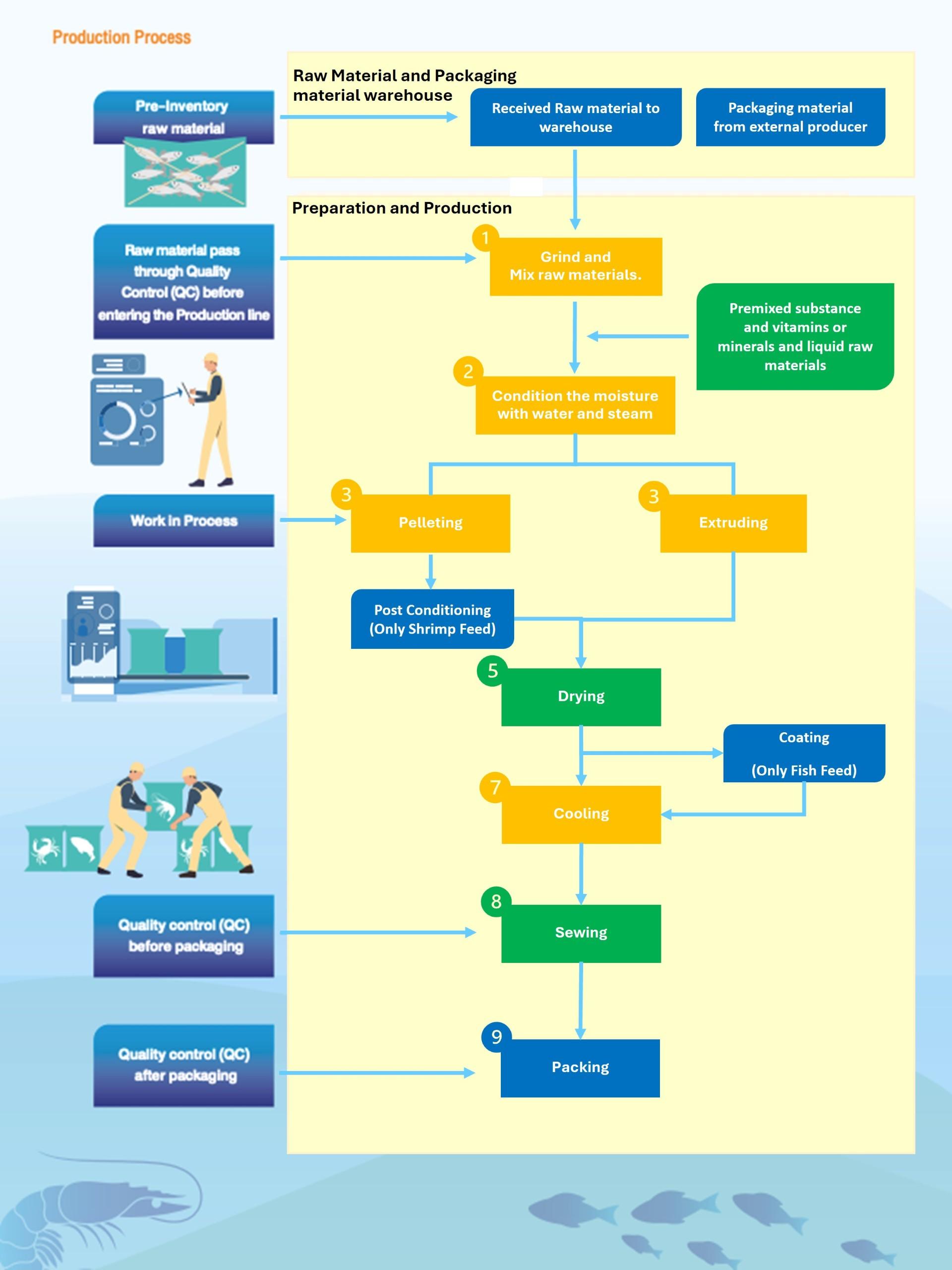
Production Policy (Overall)
The Company places strong emphasis on the adoption of digital technologies for data monitoring and analysis, which are regarded as a key driver in enhancing production efficiency. The implementation of a real-time monitoring and control platform enables the Company to closely track production status, respond promptly to potential issues, and continuously improve process stability and operational efficiency. Data-driven decision-making further supports the Company in maintaining consistent product quality and responding effectively to market demands. Guided by its operational policy that emphasizes product quality, high working standards, and sustainability, the Company has continuously developed and improved its production processes in accordance with international standards to meet the needs of customers both domestically and internationally. As a result, the Company has obtained various international quality and certification standards from leading certification bodies, reflecting ongoing confidence in the quality of its products and the robustness of its production systems. In terms of environmental and sustainability initiatives, The Company recognizes Green Procurement as an integral process of its social and environmental responsibility. Since procurement plays a crucial role in every business and has a direct impact on reducing environmental effects, the Company has continuously supported and promoted green procurement. The Company is committed to sourcing equipment, tools, and vehicles that are environmentally friendly, helping to lessen the environmental impact arising from its operations and has embedded responsible business practices through the adoption of environmentally friendly technologies across its operations. These initiatives include reducing carbon emissions through the use of electric vehicles, installing solar panels, energy-saving air conditioner and optimizing the type and usage of fuel to maximize efficiency. To support future growth, the Company continues to actively implement its investment plans. In 2025, the Company allocated a total capital expenditure budget of more than THB 300 million, primarily focused on projects promoted by the Board of Investment (BOI). These projects aim to enhance production efficiency and consistency in aquafeed quality, reduce production costs through the modernization of machinery with advanced and precise automation systems, and incorporate energy-efficient technologies into the manufacturing process. Such investments not only improve operational efficiency and cost competitiveness but also represent a significant step toward the adoption of smart manufacturing under the Industry 4.0 framework, supporting sustainable growth in both domestic and export markets.
Number of Raw-Material Distributors (Overall)
45
Production Capacity (Overall)
| Item | Unit | Used | Capacity |
|---|---|---|---|
| Feedmill Plants | Ton | 78 | 253,000 |
Domestic/Overseas Purchase Proportion (Overall)
| Raw Material | Source Country | Value |
|---|---|---|
| fish meal and dulled soybean meal | Thailand | 1,210,223,174 |
Projects Under Construction
Has Projects Under Construction (Y/N)
No
Debentures & Bills of Exchange
Has Debentures (Y/N)
No
Convertible Securities
Has Convertible Securities (Y/N)
No